Mar 30, 2026
What the AI Infrastructure Race Means for Overlooked Public Companies
The biggest capital deployment in technology history is happening right now. Most public companies will not see a dollar of it. That gap is where Altuva looks.
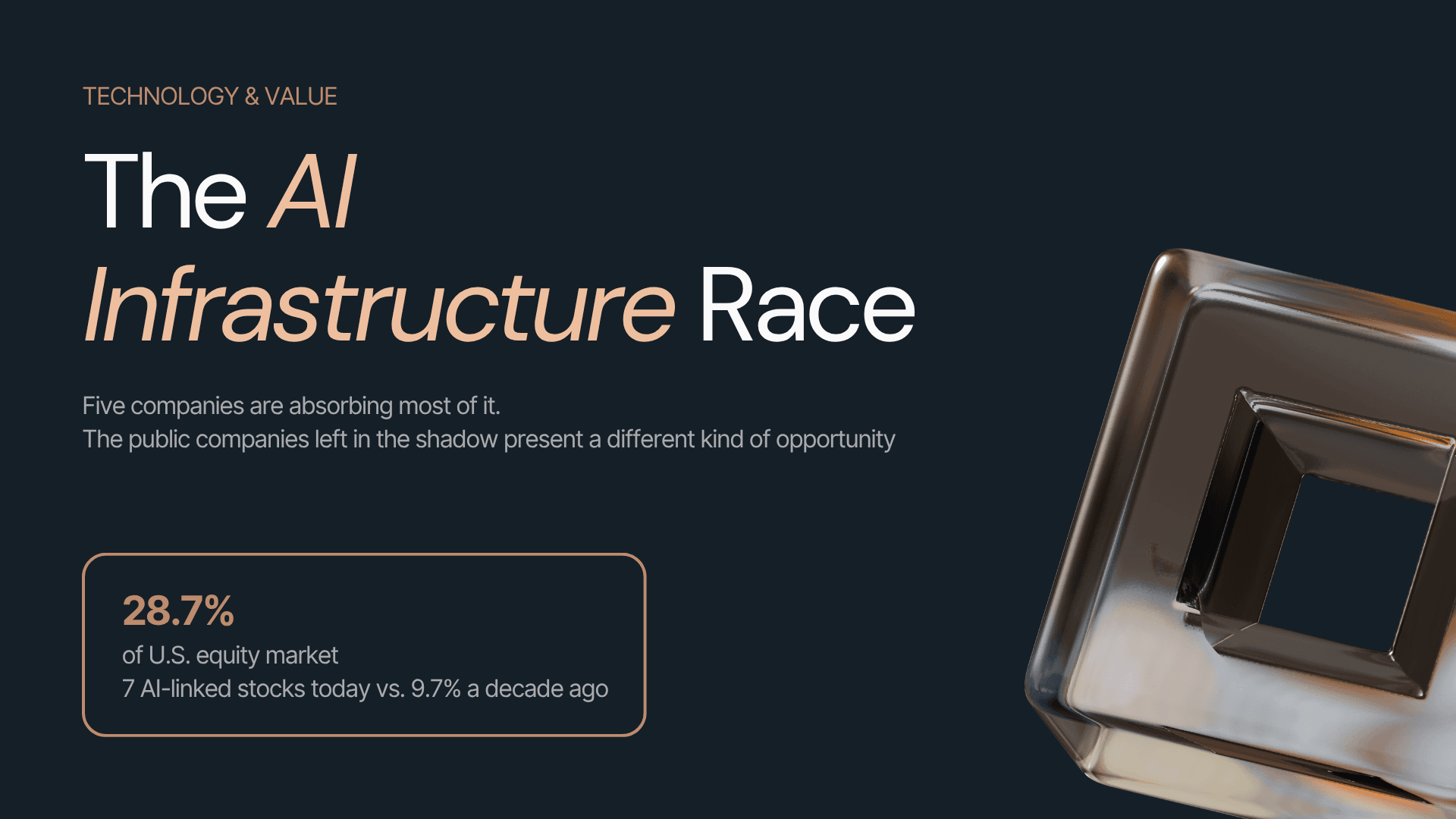
The five largest technology companies — Amazon, Alphabet, Microsoft, Meta, and Oracle — are collectively projected to spend more than $600 billion on AI infrastructure in 2026 alone, a 36% increase from 2025. [1] Approximately 75% of that figure, or around $450 billion, is directed specifically at AI-related infrastructure: data centres, compute capacity, chips, and energy systems. [1] Goldman Sachs projects total hyperscaler capex from 2025 through 2027 will reach $1.15 trillion — more than double the $477 billion spent across the preceding three years. [2]
The scale is without precedent in the history of technology investment. And for the companies at the centre of it, the returns could be generational.
But here is what that conversation almost entirely misses: for every company capturing the AI infrastructure wave, there are dozens of public companies sitting adjacent to it — fundamentally sound, quietly growing, and almost completely invisible to the capital markets.
The Concentration Problem
Market concentration in AI-related names is not anecdotal. Ten years ago, seven major AI-linked companies — Nvidia, Microsoft, Amazon, Meta, Broadcom, Alphabet, and Oracle — represented approximately 9.7% of the Morningstar U.S. Target Market Exposure Index. Today, that weight has nearly tripled, with the same group now accounting for 28.7% of the index. [3] Investors with broad market exposure are already substantially invested in the AI buildout, whether they intend to be or not.
Goldman Sachs Research confirms that equity gains have been concentrated in AI infrastructure companies, including semiconductors, hyperscalers, data centre operators, technology hardware providers, and energy companies. The group of potential AI productivity beneficiaries — companies that would benefit from AI adoption without being in the AI business themselves — has lagged the recent trajectory of their own earnings, representing what Goldman Sachs describes as an attractive risk-reward for investors seeking exposure to AI beyond the infrastructure layer. [2]
In plain terms: the market has priced the picks-and-shovels correctly. It has not yet priced the businesses that will quietly benefit from AI adoption without being in the AI business. And it has certainly not priced the smaller public companies that have been left behind entirely.
Who Gets Left Behind
Consider what it means to be a small or mid-size public company in this environment.
Enterprise software companies have seen revenue multiples compress as AI disrupts large swaths of the economy. The fear is not always rational — a business with strong recurring revenue, a loyal customer base, and a capable management team does not suddenly stop being valuable because a language model exists. But perception drives price. And right now, perception is indiscriminate in its punishment of anything outside the AI spotlight.
The result is a growing cohort of public companies that are structurally sound, operationally profitable, and trading well below what a rational assessment of their business would suggest. Not because they are broken. Because they are overlooked.
This dynamic is not new. Every major technology wave in history — the internet buildout, the mobile revolution, the cloud era — created the same pattern. Capital and attention concentrated at the frontier. Companies adjacent to the frontier got mispriced. Patient acquirers who understood the underlying businesses made excellent deals. The investors who outperformed did not do so by chasing the AI infrastructure trade. They did so by identifying what the market had forgotten in its excitement.
The Opportunity in the Shadow
The AI investment cycle is also beginning to generate real productivity gains, with businesses across industries integrating AI as a strategic operational tool. [4] Those gains will accrue to established businesses with real customers and recurring revenue — precisely the companies that are currently being overlooked in favour of AI-narrative stocks.
A company with a stable customer base, positive cash flow, and tangible assets does not become less valuable because it is not in the AI business. In many cases, it becomes more valuable as AI tools improve its operating margins, reduce its cost base, and allow it to serve more customers with the same headcount. The market has not yet priced this.
Meanwhile, investor rotation is already beginning. Goldman Sachs Research notes that investors have started shifting attention from AI infrastructure companies, where earnings growth is under pressure from intensifying capex requirements, toward companies with clearer links between capital spending and revenue generation. [2] The next phase of the AI trade, in the view of institutional research teams, involves productivity beneficiaries — companies that gain from AI without being defined by it.
What Altuva Offers These Companies
A company in this position faces a familiar set of choices. Remain independent, absorb the quarterly scrutiny, and hope the market eventually corrects its mispricing. Pursue a cash sale at a depressed valuation. Or find a partner who understands the underlying value that the market has temporarily forgotten.
Altuva acquires through all-stock mergers. No cash changes hands. No debt is loaded onto the business. The founding team and shareholders retain meaningful equity in a combined, NASDAQ-listed entity and join a platform actively working to close the gap between its companies' market prices and their actual worth.
The AI infrastructure race is not slowing down. Projections suggest between $3 trillion and $8 trillion of digital infrastructure investment by 2030 depending on the pace of AI adoption. [4] The concentration of capital and attention at the top of the market is a feature of this cycle, not a temporary distortion. And the shadow it casts over smaller public companies is not going away.
For the right companies, that shadow is the opportunity. For the right partner, this is exactly the moment to act.
The Long View
We are not trying to ride the AI wave. We are building a holding company designed to compound value across multiple cycles, multiple sectors, and a portfolio of businesses that the market has not yet learned to appreciate.
If you lead or advise a public company that is ready for a different kind of conversation, we would like to hear from you.
Altuva Group is a NASDAQ-listed public holding company focused on acquiring undervalued public companies through all-stock mergers.
-
FOOTNOTES
[1] CreditSights. "Technology: Hyperscaler Capex 2026 Estimates." know.creditsights.com, November 2025. Top 5 hyperscalers projected to spend ~$602 billion in 2026, up 36% year-over-year; ~75% ($450B) targeting AI infrastructure. Cited in Introl Blog, IEEE ComSoc Technology Blog.
[2] Goldman Sachs. "Why AI Companies May Invest More Than $500 Billion in 2026." goldmansachs.com, December 2025. Hyperscaler capex 2025–2027 projected at $1.15 trillion; equity gains concentrated in AI infrastructure; AI productivity beneficiaries lagging earnings trajectory; attractive risk-reward in AI-adjacent companies.
[3] Morningstar. "AI Arms Race: How Tech's Capital Surge Will Reshape the Investment Landscape in 2026." morningstar.com, December 2025. Seven AI-linked companies grew from 9.7% to 28.7% of Morningstar U.S. Target Market Exposure Index over 10 years.
[4] PwC. "Global M&A Industry Trends: 2026 Outlook." pwc.com. AI is spreading rapidly across industries; between $5tn and $8tn required over next five years for AI technologies and enabling infrastructure (citing BlackRock 2026 Investment Outlook and KKR Investment Insights).
[5] Futurum Research. "AI Capex 2026: The $690B Infrastructure Sprint." futurumgroup.com, February 2026. Detailed breakdown of hyperscaler capex commitments for 2026: Amazon ~$200B, Alphabet $175–$185B, Meta $115–$135B, Microsoft ~$120B+, Oracle ~$50B.